Understand the idea
Read definitions, detailed lessons and illustrations at your own pace. Revisit unfamiliar concepts before moving on.
See the hazard. Understand the risk. Make a safer decision.
Build your confidence through clear explanations, industrial scenarios and practical learning, from your first safety concepts to everyday management decisions.

Industrial safety begins with a simple question: what could harm a person doing this work, and what should prevent it? This course helps you turn that question into useful observations, reasoned controls and practical improvements.
You will explore immediate injuries and longer-term health effects, look beyond blame and learn why a completed checklist alone cannot prove that people are protected.
Suitable for people beginning their industrial safety learning, supervisors, team leaders and developing HSE practitioners who want clearer explanations of safety responsibilities.
Read definitions, detailed lessons and illustrations at your own pace. Revisit unfamiliar concepts before moving on.
Work through industrial scenarios, practical tools and knowledge checks that connect the principle with a real task.
Develop a portfolio using a suitable workplace or supplied scenario, then demonstrate your understanding in assessment.
Describe a hazard, the people exposed and the route through which harm could occur.
Contribute to risk assessment and explain why stronger controls matter.
Recognise hazards involving machinery, energy, chemicals, transport and high-risk work.
Connect occupational health, human factors and worker communication with safer work design.
Understand contractor coordination, safe work systems and management of change.
Use incident learning, monitoring and action checks to support improvement.
The course supports awareness and management judgement. High-risk work still requires appropriate competence, local procedures and the organisation’s authorisation.
Each module includes six lessons and a three-hour study allocation covering reading and practice. Open a module to see what you will explore.
Understand why industrial harm occurs, how responsibilities are assigned, and how a working management system turns intentions into reliable protection.
Build a useful risk assessment from a real task, select stronger controls, and confirm that the work remains within the conditions assessed.
Recognise dangerous motion and energy, understand the purpose of safeguards and isolation, and make safe decisions during use, cleaning, maintenance and return to service.
Recognise how substances and physical agents can harm health, assess real tasks rather than labels alone, and select exposure controls that remain effective during routine work, maintenance and cleaning.
Connect prevention of ignition and dangerous releases with reliable alarm, evacuation and emergency coordination. Practise decisions that protect people while leaving specialist intervention to trained and equipped responders.
Recognise activities where a single failed safeguard can cause fatal harm. Use competent planning, verified physical controls, coordinated authorisation and a clear stop decision before high-risk work begins or changes.
Design safer movements of vehicles, people and materials, then reduce the physical demands that remain in industrial work.
Recognise major loss-of-control scenarios, protect critical barriers and manage the interfaces and changes that can weaken them.
Design work that supports reliable human performance, respectful communication and verified coordination of safety-critical tasks.
Turn incidents, worker concerns and performance evidence into better controls. This module connects prompt reporting, fair investigation, verified corrective action and management review.
Total Qualification Time (TQT) is the planned time for learning, independent practice and assessment. Plan regular study sessions and allow time to reflect.
Read the ten modules, explore examples, use the tools and complete knowledge checks.
Connect your learning with an appropriate workplace or supplied scenario.
Prepare and complete the assessment after your allocated learning.
This is self-paced study. TQT does not mean 40 hours of live teaching or 40 continuous hours.
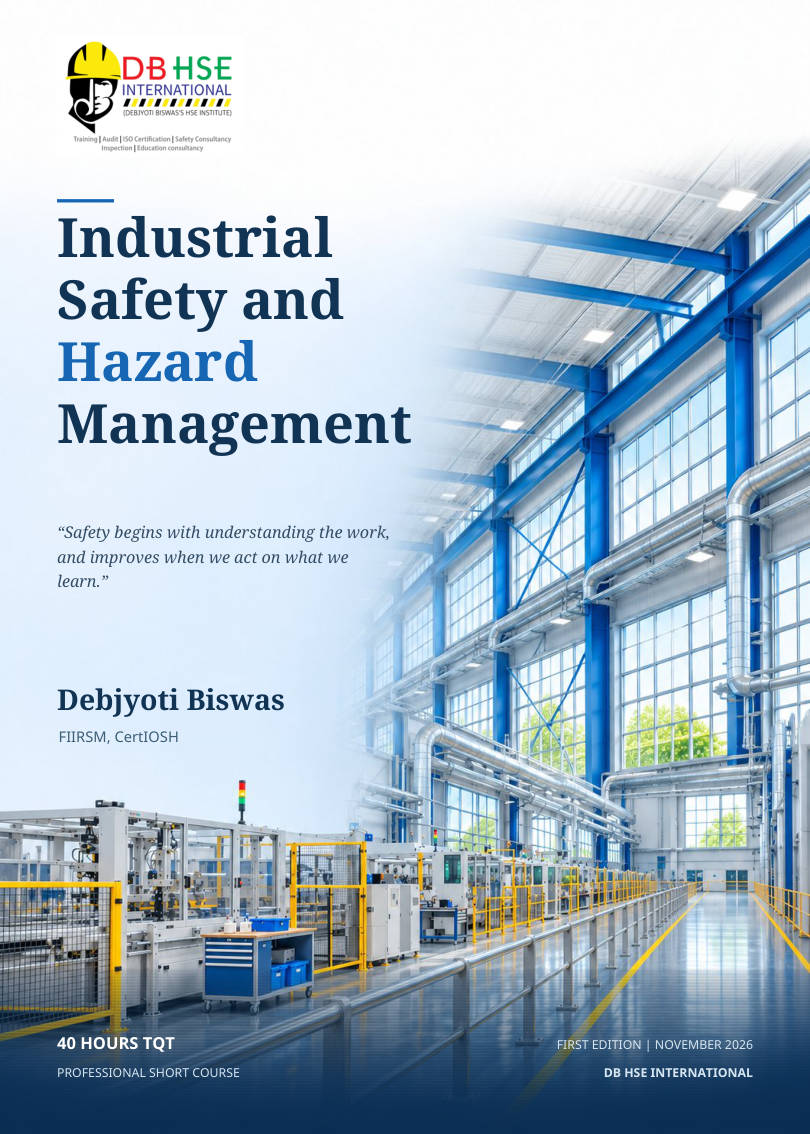
The 369-page course book brings the learning together with detailed explanations, industrial scenarios and illustrations. Read alongside the LMS, return to difficult topics and use the practical activities to develop your reasoning.
Sign in with the learner account provided by your DB HSE administrator to access the book and course resources.
Use the online admission portal and provide the enrolment information requested by DB HSE.
The administrator provides your learner email or username and password. You may change your password after signing in.
Start with the welcome letter and study plan. Download your book inside the LMS, then follow the modules and activities.
Complete the learning and portfolio, then request your assessment when you are ready.
Spread your learning over at least five study days. Day 6 is the earliest possible assessment issue date; request it only after completing the allocated learning and when you feel ready. The 24-hour submission window starts when your assessment is issued.
A DB HSE INTERNATIONAL course completion certificate is issued after successful assessment.
Contact DB HSE INTERNATIONAL to discuss the course, suitability and enrolment.